


Key Takeaways
- Many adults aren't struggling to sleep so much as struggling to stop thinking, the day keeps replaying even after the lights go off.
- An evening routine works less like a checklist and more like a transition ritual, a bridge between finishing your responsibilities and actually letting yourself slow down.
- Something as simple as dimming the lights or turning on a calming galaxy projector can become the visual signal that tells your brain it's time to relax.
You finally finish your day. The lights are off, your phone is nearby, and you know you should relax, but your mind keeps replaying conversations, tasks, and tomorrow's plans.
The problem isn't always sleep itself. Sometimes it's the transition before sleep, the missing step between finishing your day and actually letting your mind settle.
It's easy to assume the fix is a better mattress, a sleep app, or simply going to bed earlier. But for a lot of adults, none of that addresses the real issue: nothing in the evening has actually told their mind that the day is over.
Table of Contents
- Why Adults Struggle to Relax Before Bed
- What Is an Evening Routine for Better Relaxation?
- 7 Relaxing Things to Do Before Bed
- How Your Bedroom Environment Affects Relaxation
- Creating Your Personal Evening Reset Space
- FAQ
Why Adults Struggle to Relax Before Bed
Your brain is often still processing the day long after you've technically stopped working. Unfinished tasks sit unresolved in the back of your mind, decisions you made or postponed keep replaying, and conversations from hours earlier can resurface right as you're trying to fall asleep. None of this is a conscious choice. It's simply what a busy, unfinished mind does once it finally has a quiet moment to itself.
Screens make this harder to shake off. Even after work technically ends, a phone within reach keeps offering something new to react to: an email that could easily wait until morning, a headline, a message from a group chat. Each one seems minor on its own, but together they keep your mind in the same reactive, alert state it was in all day.
Underneath both of these is a bigger issue: there's often no clear signal that the day is actually over. In an office, walking out the door used to do that job. Without it, a challenge that's especially pronounced if you work from home, it's easy for your mind to stay half-on well past bedtime, simply because nothing in your evening marked the shift.
What Is an Evening Routine for Better Relaxation?
An evening routine isn't another checklist to get through, and it's not about optimizing every minute after work. It's closer to a transition ritual: a deliberate, repeatable way of moving from one state of mind into another.
The shift usually happens in three parts. First, you finish, or consciously set aside, your responsibilities for the day. Then you create a few calming signals, small, repeatable cues like dimmer lighting or a change of scenery, that your brain starts to associate with winding down. Finally, you allow yourself to actually slow down, rather than expecting relaxation to happen automatically once the tasks are done.
The routine itself matters far less than the shift it creates. Two people can have completely different evening routines and get the same result, as long as each routine reliably signals the same thing: the day is done.
7 Relaxing Things to Do Before Bed
A few consistent habits are usually enough to create that shift. None of these need to take long, and you don't need to do all seven every night to notice a difference:
- Dim your lights and change your environment. Softer lighting is one of the clearest signals you can give your brain that the day is ending, not a sleep aid, just a visual cue to relax, and it works whether you simply dim an existing lamp or bring in something new.
- Create a screen-free wind-down moment. Even fifteen minutes away from a screen gives your mind room to settle instead of continuing to react to whatever shows up next.
- Read something enjoyable. A few pages of something you actually like, not work-related, not something you feel obligated to finish, helps shift your mind out of the day and into something that's genuinely yours.
- Write down tomorrow's tasks. Getting them out of your head and onto paper can meaningfully lower the mental load you're carrying into bed, since your mind no longer has to keep holding onto them just to avoid forgetting.
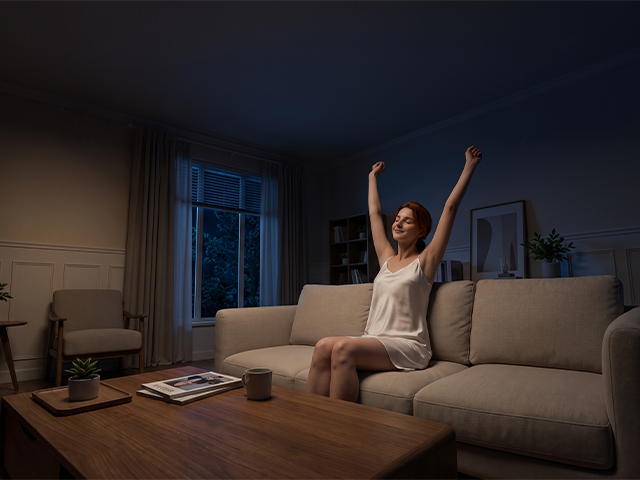
- Practice gentle stretching. A few slow movements help release the physical tension that built up over the day, even if you spent most of it sitting still.
- Listen to calm music. Quiet, familiar sound can mask racing thoughts and fill the silence without demanding the kind of attention a screen does.
- Build a consistent night ritual. Whatever combination of these you choose, repeating it in the same order each night is what actually makes it effective over time; consistency does more of the work than any single habit.
How Your Bedroom Environment Affects Relaxation
Your bedroom plays a bigger role in relaxation than most people realize. Lighting sets the tone before you've consciously registered it: warm, dim light reads as evening, while bright, cool light reads as daytime, regardless of the actual hour. Color and texture matter too. Soft, familiar fabrics and muted tones tend to feel restful, while visual clutter, piles of laundry, unfinished projects, cluttered surfaces, quietly keeps your mind cataloguing things left to do.
None of this needs to add up to a full redesign. The goal isn't necessarily to improve sleep quality directly, or to create a magazine-worthy room. It's to create a space where your mind feels ready to rest in the first place, which is a lower bar, and a far more achievable one, than perfecting every detail.
Creating Your Personal Evening Reset Space
A personal reset space doesn't need much: a comfortable chair, a warm light, and a few minutes set aside just for you, after work, before bed, or any quiet moment alone during the day. What matters most is that it's consistent and that it's yours, somewhere your mind has learned to associate with slowing down rather than one more task on the list.
This is where lighting becomes more than background. Something like a galaxy projector, sometimes called a planetarium projector, can work as a reading companion or a simple calming visual, filling the room with slow-moving light that makes the space feel like it's genuinely time to relax, rather than another transition you have to manage on your own. It's a small addition, but a consistent one, which over time is often what makes the biggest difference.
Shop the POCOCO Galaxy Projector →
FAQ
How can I relax before sleep?
Start by creating a short, deliberate transition between your day and your bedtime, even ten to fifteen minutes is enough to make a difference. Dimming the lights, stepping away from screens, and doing one calming activity consistently can help your mind register that the day has actually shifted, rather than expecting it to wind down on its own.
Why do I feel stressed before bed?
Nighttime is often the first quiet moment your mind has had all day, so unfinished tasks, decisions, and conversations tend to surface all at once, simply because there's finally space for them to. It's less about the night itself causing stress and more about a lack of a clear transition beforehand that would have let you process things earlier.
What are relaxing things to do before bed?
Low-stimulation activities tend to work best: reading, gentle stretching, calm music, or writing down tomorrow's tasks to get them out of your head. The specific activity matters less than doing it consistently, as part of a routine your mind comes to recognize.
How can I create a relaxing bedroom environment?
Soft, warm lighting, a little less visual clutter, and a few comforting, familiar textures all help more than people expect. The goal is a room that feels calm to simply be in, not necessarily one optimized purely for sleep quality.


Hinterlasse einen Kommentar
Alle Kommentare werden vor der Veröffentlichung geprüft.
Diese Website ist durch hCaptcha geschützt und es gelten die allgemeinen Geschäftsbedingungen und Datenschutzbestimmungen von hCaptcha.